

 Ben Stokes
  03 June 2026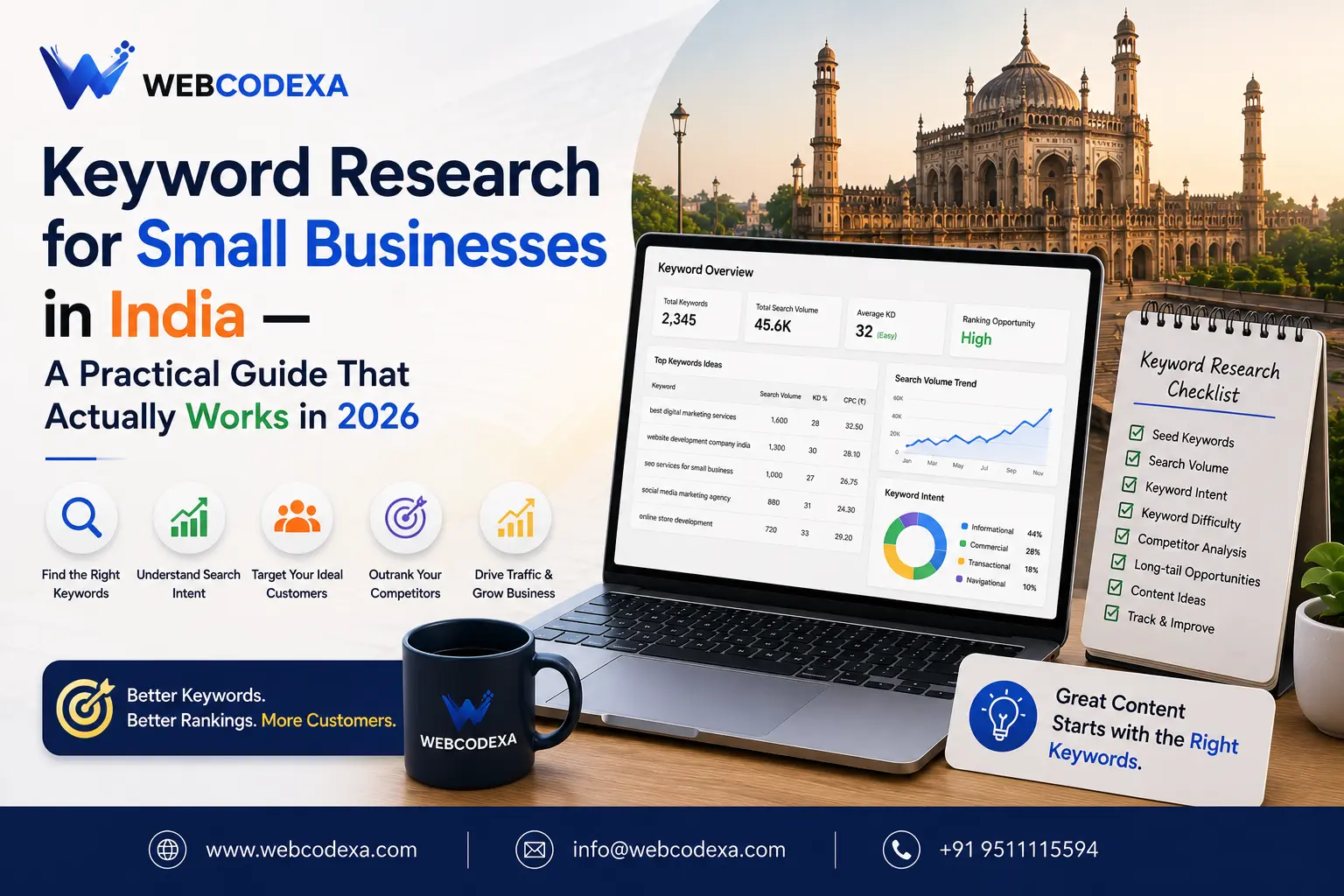
Keyword Research for Small Businesses in India — A Practical Guide That Actually Works in 2026
Most keyword research guides are written for large companies with dedicated SEO teams and access to expensive tools. This one is written for a small business owner in India — someone who sells products or services locally, does not have hours to spend on spreadsheets, and wants practical answers, not theory.
If you want to know how to find the words and phrases your potential customers are actually typing into Google — so you can create content that shows up when they do — this guide is exactly what you need.
What Is Keyword Research and Why Does It Matter?
Keyword research is the process of finding out what words and phrases people type into Google when they are looking for products or services like yours. When you know this, you can create web pages and blog posts that match those searches — and appear in front of customers who are actively looking for what you sell.
Done well, keyword research is the difference between writing content that gets zero traffic and writing content that brings enquiries every week. Done poorly — or not at all — you end up with a website that talks about your business the way you talk about it, not the way your customers search for it.
Example: A Lucknow coaching institute might describe their service as “quality educational support for competitive examinations.” But their customers search “UPSC coaching Lucknow fees” and “best IAS coaching near me Lucknow.” If the website does not contain those phrases, it will not appear for those searches — no matter how good the institute actually is.
Step 1 — Start With What You Know: Seed Keywords
A seed keyword is the basic term that describes your business. You already know these. Write down 5–10 of them. For a Lucknow interior designer:
- interior designer
- interior design Lucknow
- home interior designer
- office interior design
- modular kitchen Lucknow
These are your starting points. They are probably competitive — many businesses are targeting the same terms. The research process that follows will help you find the variations that are more specific, less competitive, and more likely to convert.
Step 2 — Use Google Itself (Free and Incredibly Useful)
Before any tool, use Google. Search one of your seed keywords and look at three things:
Google Autocomplete
Start typing your keyword and look at what Google suggests to complete it. These are real searches that real people are doing frequently. “interior designer Lucknow” might show: “interior designer Lucknow fees”, “interior designer Lucknow Gomti Nagar”, “interior designer Lucknow cost per sqft.” Each of these is a keyword opportunity.
People Also Ask
The box on the results page that shows related questions (“People Also Ask”) is keyword gold. These are exact questions your potential customers are asking Google. Each question is a potential blog post or FAQ section on your website.
Related Searches
Scroll to the bottom of the Google results page. The “Related searches” section shows 8 variations on your keyword. These often reveal search angles you had not considered.
Step 3 — Use Google Keyword Planner (Free)
Google Keyword Planner is a free tool inside Google Ads (you need a Google Ads account but you do not need to run any ads). It shows you search volume data for keywords in India and lets you find related keywords.
How to use it for local keyword research:
- Go to ads.google.com → Tools → Keyword Planner
- Choose “Discover new keywords”
- Enter your seed keywords
- Set location to your city (Lucknow) or state (Uttar Pradesh)
- Set language to English (and Hindi if relevant)
- Review the results for monthly search volume and competition level
What you are looking for: keywords with meaningful monthly searches (50+ for a local keyword is significant), moderate competition, and clear buyer intent. “Interior designer Lucknow cost” with 200 monthly searches and low competition is more valuable than “interior design” with 10,000 searches and extreme competition from national and global sites.
Step 4 — Understand the Three Types of Keyword Intent
Not all keywords are equal. The intent behind a search determines whether the person is likely to become a customer.
Informational Intent
The person wants to learn something. “What is modular kitchen”, “how much does interior design cost in India”, “tips for small living room design.” These searches are best answered with blog posts and guides. They bring traffic but convert later — the person is researching, not buying yet.
Commercial Intent
The person is comparing options before deciding. “Best interior designer in Lucknow”, “interior designer Lucknow reviews”, “top 10 interior designers Lucknow.” These are high-value searches. Appearing here means being considered.
Transactional Intent
The person is ready to hire or buy. “Interior designer Lucknow contact number”, “interior designer Gomti Nagar price”, “interior designer near me Lucknow.” These searches convert at the highest rate. They should be targeted on your service pages and Google Business Profile.
A strong keyword strategy targets all three — blog posts for informational, strong service pages for commercial and transactional.
Step 5 — Find the Local Advantage
For a small business in Lucknow, local keywords are where you can genuinely compete. A national interior design company cannot rank for “interior designer Hazratganj Lucknow” as easily as a local business can. Local specificity is your competitive advantage.
Local keyword variations to explore:
- [Service] + Lucknow
- [Service] + [Neighbourhood] (Gomti Nagar, Hazratganj, Alambagh, Indira Nagar, Aliganj, Vikas Nagar)
- [Service] + near me (Google personalises these results heavily for local businesses)
- Best [service] in Lucknow
- Affordable [service] Lucknow
- [Service] Lucknow fees / cost / price / charges
Step 6 — Check What Your Competitors Rank For
Your competitors have already done keyword research — even if they did it accidentally. By looking at what pages on competitor websites rank on Google, you can quickly identify valuable keywords you may have missed.
Free method: Search your most important keywords and look at which local competitors appear. Visit their websites and look at their page titles, headings and blog posts. What topics are they covering? What questions are they answering? What keywords appear in their URLs? This is not about copying — it is about mapping the competitive landscape.
If a competitor has a blog post titled “Living Room Interior Design Ideas for Small Flats in Lucknow” and it ranks well, that tells you there is search demand for that topic. Create a better, more detailed version.
Step 7 — Build a Simple Keyword Map
Once you have a list of keywords, organise them into a simple map that connects each keyword to a specific page on your website:
- Home page → your broadest primary keyword (“interior designer Lucknow”)
- Service pages → specific service keywords (“modular kitchen Lucknow”, “office interior design Lucknow”)
- Blog posts → informational and long-tail keywords (“how much does interior design cost in Lucknow”, “small bedroom design ideas Lucknow”)
- Contact page → transactional keywords (“interior designer Lucknow contact”, “hire interior designer Lucknow”)
Every page should have one primary keyword it is trying to rank for. Do not try to target five keywords with one page — create five pages.
Need Help With Keyword Research for Your Lucknow Business?
Webcodexa provides keyword research and content strategy as part of our SEO services. We do not just hand you a spreadsheet — we build a complete content map that connects your business goals to real customer searches, and then we execute the content to rank for them.